

My True Story Behind Calle Goya
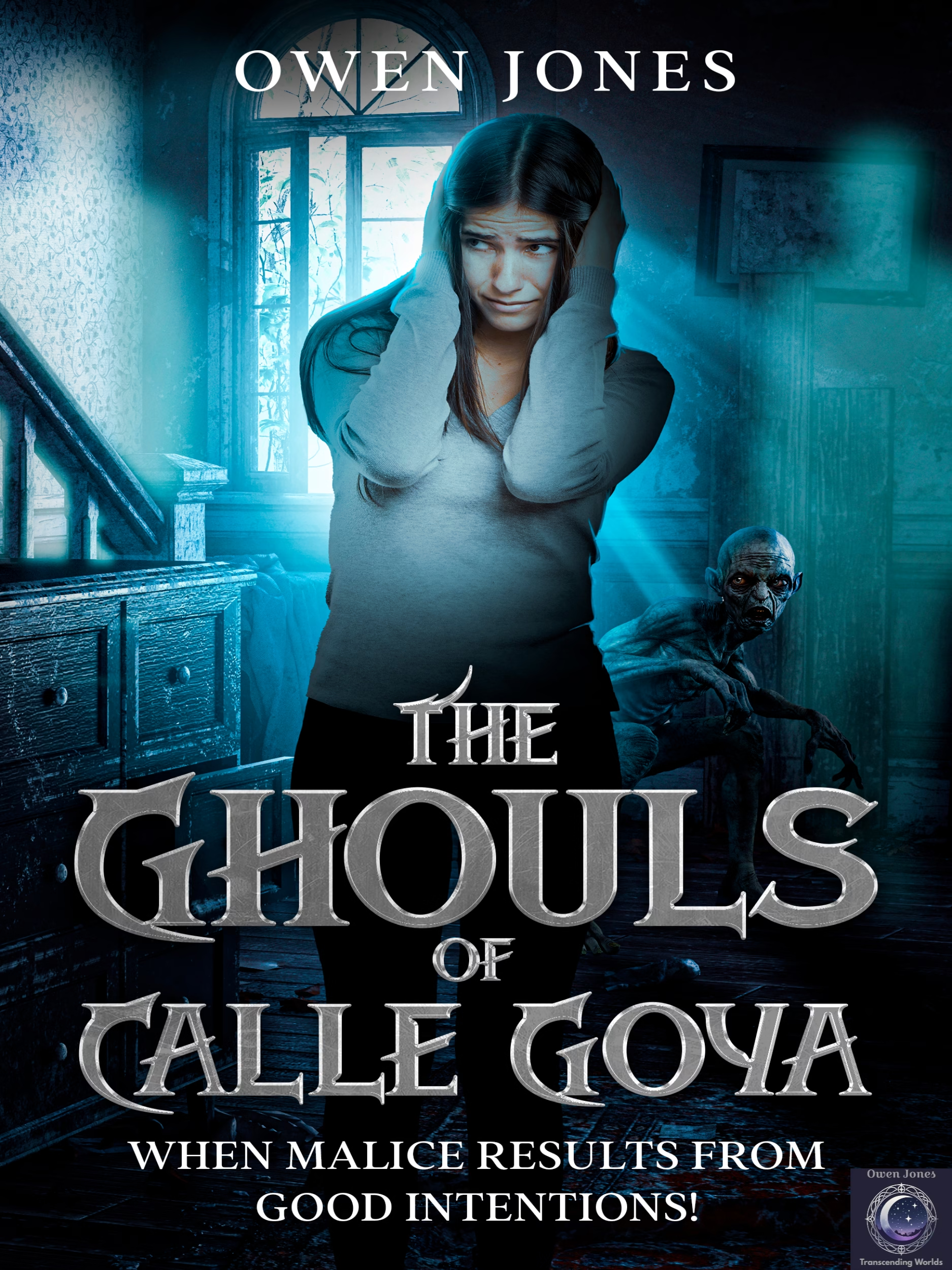
Readers often ask how much of The Ghouls of Calle Goya is real. The true story behind Calle Goya is stranger than you’d expect — not because of anything supernatural, but because of how ordinary the street looked while something was quietly going wrong on it.
Life on an Ordinary Street
My wife and I lived on Calle Goya, in Fuengirola, for three or four months. For most of that time it was exactly what you’d picture: sun on the balconies, quiet mornings, the unhurried rhythm of a seaside Spanish town going about its day. Nothing about the street suggested it would end up in a novel, let alone a ghost story.
Then we got neighbours.
The Night Everything Changed
A group of Norwegian teenagers moved into the flat next door, one floor above us. One night, drunk and locked out of their own apartment, they turned up at ours with a plan: jump from our first-floor balcony across to theirs. We said no. It wasn’t a difficult decision — it wasn’t safe, and it wasn’t a problem of our making to solve at whatever hour of the night this was.
They didn’t take the refusal well.
What followed wasn’t a single dramatic incident. It was smaller than that, and in some ways harder to describe — a sustained, deliberate effort to frighten and unsettle my wife, right there in what should have been the calm centre of our stay. Nothing you could easily report to anyone. Nothing that would photograph as evidence. Just the slow erosion of feeling safe somewhere that had no business feeling unsafe.
That’s the true story behind Calle Goya: not one terrifying night, but weeks of something quietly, persistently wrong — the kind of unease that’s almost impossible to explain to someone who wasn’t there, and almost impossible to shake once you have been.
How the True Story Behind Calle Goya Became a Novel
I didn’t sit down to write memoir. But that feeling — the specific, low-grade dread of a place you can’t trust anymore — stayed with me long after we left, and it became the engine of the book.
The Ghouls of Calle Goya follows Frank, a London banker, and his new wife Joy, arriving at a borrowed apartment on the same street for what should be a quiet honeymoon. What they find instead is a secret Scandinavian society, presided over by the old-worldly Baron Sedolfsen, and a fear that starts small and refuses to stay that way.
Joy’s story doesn’t stay in Spain, either. It follows her back to her family’s village in northern Thailand, where suspicion and misunderstanding compound what’s already unravelling — a reminder that this kind of fear doesn’t need distance to lose its grip on you.
Why an Ordinary Street Makes the Best Setting
There’s no crumbling gothic mansion in this book, no fog-wrapped moor. Just balconies, washing lines, and the everyday hum of a Spanish street — the same hum Calle Goya actually has. I think that’s exactly why psychological horror works best in places like it. The less a setting asks to be feared, the further a mind has to travel to get there, and the more unsettling it is to watch that journey happen, one small wrongness at a time.
The People I Never Knew
I never learned the names of the neighbours who lived beside us that summer. In a way, that feels right. They were never really the point of the true story behind Calle Goya that I keep returning to — what stayed with me was the street itself, and how quickly somewhere safe can stop feeling that way.
The Ghouls of Calle Goya is part of my Costa del Sol Collection, alongside Andropov’s Cuckoo and Daisy’s Chain — three novels rooted in the same stretch of coast, each finding its own kind of unease in familiar places.
Where to Find The Ghouls of Calle Goya
- eBook and paperback: Megan Publishing Services
- Paperback: Bookshop.org | Waterstones
- Audiobook: Tektime
If Calle Goya’s real streets, or its imagined ones, have ever unsettled you the way they unsettled us, I’d love to hear about it in the comments below.
Discover more from Megan Publishing Services
Subscribe to get the latest posts sent to your email.